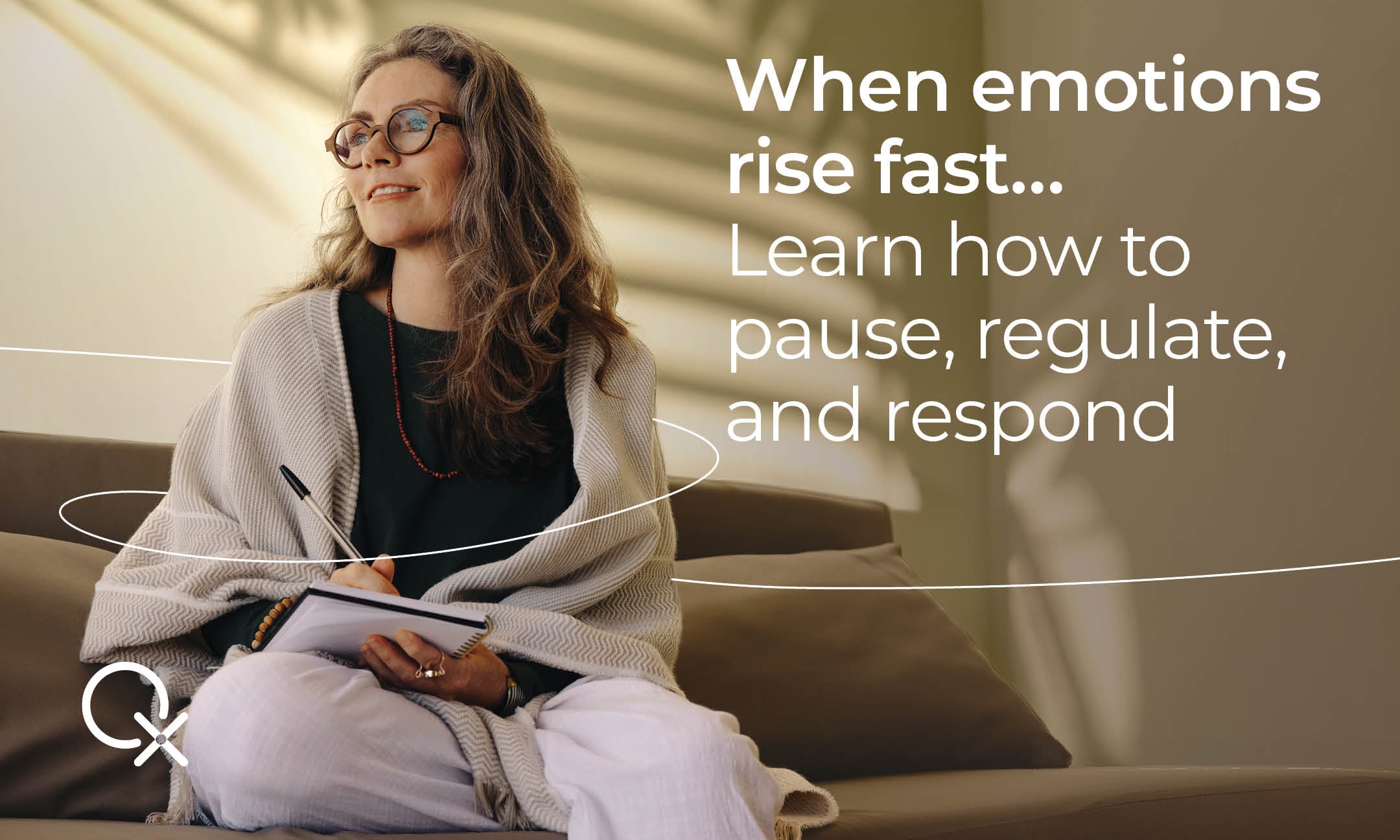

Some days, it’s not the “big things” that throw us off—it’s the small, constant moments: a sharp email, a tense conversation, a rushed morning, a body already carrying stress. When your system is loaded, emotions rise faster, words come out sharper, and you can end up reacting in ways that you do not like and just don’t feel like you.
That’s where emotional regulation comes in—not as “being calm all the time,” but as learning how to notice what’s happening inside you, create a little space, and respond with more choice. This article focuses on practical, real-time emotional regulation skills you can use in everyday moments—especially when emotions rise fast.
You’ll learn what emotional regulation is, why it matters, practical emotional regulation techniques you can use immediately, and real-life emotional regulation examples. You’ll also learn how biofeedback—especially the RIVE program from QX World—can be a targeted support tool for emotional awareness and self-regulation, including as a complement to other modalities people may already be using.
Emotional regulation is the ability to bring awareness to an emotion as it arises, understand what it’s signaling, and choose a response that fits the moment. You still feel anger, sadness, fear, joy, or excitement—emotional regulation simply gives you flexibility and choice in how you respond.
That’s why practising awareness matters. The more quickly you can notice what’s happening inside you—tightness in your chest, a racing mind, a surge of defensiveness—the more space you create between feeling and reacting. That space is where self-control lives: not in forcing emotions away, but in staying connected to your internal experience while still being able to pause, communicate, and recover.
Emotional regulation isn’t suppression. It’s not pretending you’re fine. And it’s not “controlling” emotions by force. Healthy emotional regulation is learning to work mit your emotions—so they can inform you without taking over.
A helpful way to think about it:
Strong emotional regulation changes daily life in very practical ways:
When emotional regulation is harder, life can feel like a string of urgency—followed by regret. When emotional regulation improves, you don’t become emotionless—you become steadier.
Why Emotional Regulation Can Feel So Hard
Many people struggle with emotional regulation because the nervous system is designed to prioritize safety and speed, not perfect communication. Under stress—especially in long-term difficult situations, where stress isn’t just a moment but a constant background load—the body can shift into automatic survival responses (fight, flight, freeze, or appease) before the thinking brain fully comes online. If PTBS or CPTSD is present, this can happen even faster. You might react before you can even squeeze in a thought, because the threat-response system fires first—tight chest, heat, trembling, heart racing, sweating, or a sudden shift into shutdown, defensiveness, or people-pleasing—while the thinking brain catches up afterward. When someone has lived through—or is living through—shock, trauma, abuse, or long-term stress, the nervous system can become more easily activated and slower to settle. Repeated experiences of unpredictability or emotional invalidation can train the system to stay on high alert, making reactions faster and recovery slower.
Over time, patterns like shutdown, hypervigilance, people-pleasing, or emotional flooding can become protective defaults rather than conscious choices. None of this means something is wrong with you; it means your responses were shaped by what you’ve lived through—or are living through—and reinforced over time. The encouraging part is that emotional regulation is learnable—especially when you start with awareness, practice small skills consistently, and focus on recovery and repair rather than perfection.
Many people struggle with emotional regulation in ways that look different on the outside but feel similar on the inside:
These aren’t character flaws. They’re common nervous-system responses—especially when life is demanding or when someone never had good models for regulating emotions in the first place.
When the nervous system is on high alert, the body often reaches for fast relief—usually sugar, caffeine, alcohol, or ultra-processed snacks—because they can quickly shift energy, mood, or tension. The downside is that these quick fixes can increase blood-sugar swings, disrupt sleep, and keep stress physiology activated, which can make emotional regulation harder later. Supportive nutrition doesn’t have to be complicated: regular meals with protein + fiber + healthy fats, steady hydration, and mineral-rich foods can help stabilize energy and reduce the “crash” that fuels reactivity. In an activated moment, a simple reset is to pause and ask: “Do I need water, food, or grounding?”—then choose something that supports steadiness, like a protein snack, herbal tea, or a balanced meal.
If you can understand the process, you can intervene earlier. A simple emotional regulation process looks like this:
You can remember it like this: awareness → interpretation → response choice → recovery.
What Are the 5 Emotion Regulation Strategies? (Plus 2 Bonus Tools)
People often ask, what are the 5 emotion regulation strategies—especially when emotions rise fast and the moment feels bigger than your capacity. Here’s a clear, practical set you can use in real time. These strategies don’t remove emotion. They create space around it, so you have more choice in what happens next.
1) Notice and name the emotion (awareness + labeling): This is one of the most effective emotional regulation techniques because it turns a vague flood into a clear signal.
Example: “I’m feeling embarrassed and tense.” “I’m hurt and defensive.”
2) Regulate the body (longer-exhale breathing): A longer exhale helps settle the stress response and supports how to regulate emotions in the moment.
Try: inhale for 4, exhale for 6—repeat 3 rounds.
3) Ground in the present (5–4–3–2–1): This reduces overwhelm and brings you back into the here and now.
Try: 5 things you see, 4 you feel, 3 you hear, 2 you smell, 1 you taste.
4) Reframe the meaning (a second possible interpretation): Reframing isn’t forcing positivity—it’s testing a second perspective.
Example: “That tone might be stress, not rejection.”“My body is alarmed, but I’m safe.”
5) Act from values (choose a response that fits who you want to be): This turns emotional intensity into clarity about how you want to show up.
Example: “I’m upset—and I’m going to speak clearly and respectfully because repair matters.”
In conflict, the 5 emotion regulation strategies look like this: notice and name what you feel, take a steadying breath, stay present in your body and the conversation, reframe the meaning with a second possible interpretation, and then respond from your values rather than your impulse. Under stress, the same 5 emotion regulation strategies apply with a slightly different emphasis: notice and name the emotion early, regulate the body (often with a longer exhale), ground yourself in the present moment, reframe what’s happening, and choose one next step that is realistic and aligned with how you want to show up.
If you want extra support, two bonus emotional regulation techniques can make these strategies easier to access in real life. Attention shifting helps you move from spiraling to a single helpful focus—without denying what you feel.
Example: “What’s the next smallest step I can take right now?”
A second bonus is using a micro-boundary—a brief pause before responding—so you can step out of the trigger long enough to reply well.
Example: “I want to respond thoughtfully—can we talk in 20 minutes?”
Emotion regulation skills are learnable. They build through repetition, reflection, and support—not by being “good” at emotions, but by practicing the same small skills again and again.
Schlüssel emotion regulation skills umfassen:
As these emotion regulation skills strengthen, emotional regulation becomes more consistent—especially under pressure.
How to Regulate Emotions in the Moment (A 60-Second Reset)
Think: Name → Breathe → Ground → Choose.
A quick reset you can use in everyday stress—at work, in conflict, and in any moment that starts to escalate.
Emotional regulation therapy can be skills-based (like CBT, Cognitive Behavioral Therapy, oder DBT, Dialectical Behavior Therapy), somatic (body-based), trauma-informed, or coaching-based—different approaches with a similar goal: building awareness, flexibility, and healthier responses.
Importantly, regulation tools can complement a range of supportive modalities. When people can notice their stress response and triggers in real time, it’s often easier to connect the dots—and practice regulation skills more consistently in everyday life.
Emotional Regulation and Biofeedback: Awareness You Can Practice
Biofeedback is often used as a non-invasive way to support emotional awareness and self-regulation—by reflecting patterns of activation and recovery. The idea is not “fixing” you. It’s learning your system, so you can work with it.
This is where the RIVE program from QX World fits in as a targeted support tool.
RIVE is a QX World Biofeedback program designed to support stress and emotional self-regulation by increasing real-time awareness of the body’s responses and providing gentle, feedback-based training. It can be used as a supportive tool alongside professional care or other modalities.
In practice, RIVE helps users notice activation earlier and practice steadier responses—especially when emotions escalate quickly. It monitors stress-related signals (such as skin conductance/GSR, muscle tension, heart rhythm patterns, and brainwave activity) to create a clearer picture of internal state and response.
From an emotional regulation perspective, RIVE can support:
RIVE is also designed to be user-friendly, which matters because regulation is hardest when you’re activated—tools work best when they’re simple enough to use consistently in real life.
Here are practical emotional regulation examples—real moments where skill changes the outcome.
These emotional regulation examples are not about never reacting. They’re about building a faster return to choice.
If you’re asking how to improve emotional regulation, the answer is usually: consistency, not perfection.
The inspiring truth is this: emotional regulation improves when your system learns that intensity is survivable—and that you can stay with yourself through it.
Emotional regulation is the skill of noticing emotions, understanding them, choosing responses with more flexibility, and recovering after stress. Emotional regulation techniques like labeling, breath, grounding, reframing, values-based responding, and micro-boundaries create the pause where choice becomes possible. Over time, emotion regulation skills become steadier—especially in real life, where things are messy.
Biofeedback can support this learning process by making stress patterns more visible. The RIVE program from QX World is positioned as a targeted, user-friendly, supportive biofeedback tool for stress and emotional overwhelm—and it’s explicitly described as supportive, making it suitable as a complement to modalities people may already be using.
If you’d like to learn more about RIVE—or see how the system works in practice—visit QX World’s quantum biofeedback page oder explore our RIVE demo and educational resources.