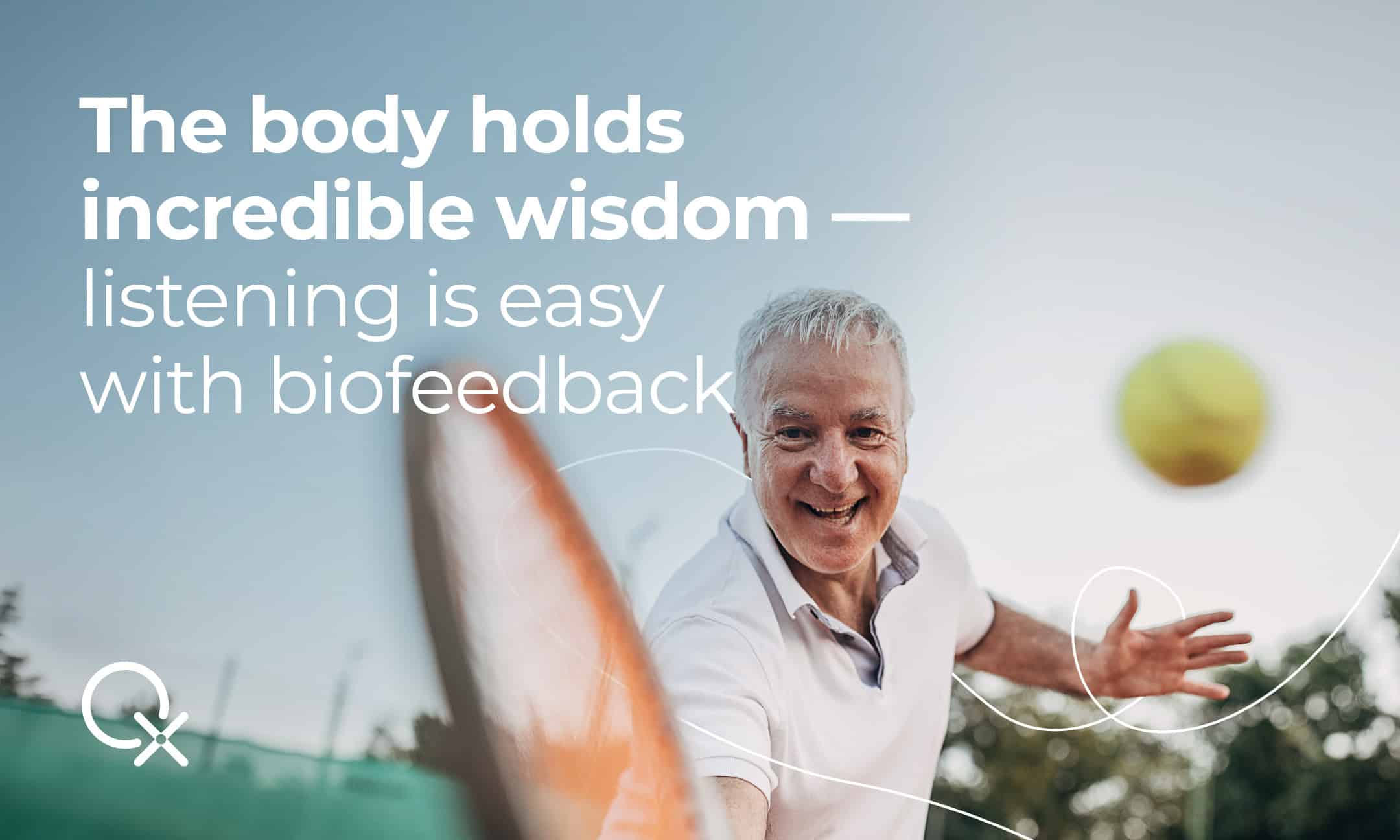

Som you get older, your body changes. Sometimes, it can feel like det er no longer on your side. By showing you how your body responds til stress eller pain, biofeedback gives you the tools to understand what’s happening inside your body. You learn to koble til with your body and relesome tension with greater ease. Biofeedback reminds you that your wellbeing is in your hands, no matter your age. Read on to discover hva biofeedback er, along with some of its key fordeler.
You’ve probably seen or experienced an ECG, also known as electrocardiography. During the test, small sensors are placed on your chest, abdomen, wrists and ankles while you sit or lie down. These sensors are connected to a device that records your body’s signals in real time – in this case, your heartbeat. On the screen, you can see your heart’s rhythm as a moving line, which a specialist later interprets.
At QX World, we’ve elevated traditional biofeedback by integrating it with cutting-edge quantum technology. Our quantum biofeedback systems combine several interconnected components that communicate with the body on a deeper energetic level, detecting and responding to subtle stress patterns that influence physical, emotional, and mental well-being.
During a quantum biofeedback session, real-time data are also collected and undergo computer analysis, but the pattern that is highlighted on the screen is a stress pattern. And unlike with an ECG, the process doesn’t stop there. Gentle, corrective signals are sent back to you, helping your body find its balance again.
By translating these energetic signals into meaningful data, our quantum biofeedback technology helps create greater self-awareness and supports the body’s natural ability to restore balance. The result is a more comprehensive, holistic approach to wellness – one that bridges science and energy to promote harmony from within.
In your sessions, or when you first start learning about what biofeedback is, you might come across some terms that feel unfamiliar. To help you understand how the technology works, especially in systems designed for the elderly, here’s an overview of a few key physiological measurements:
Biofeedback sessions are built around a few core elements, each playing a role in helping you tune into your body’s signals.
Today’s biofeedback systems are designed with your comfort and quality of life in mind. They focus on easing pain, improving balance and mobility, and boosting confidence and strength.
Biofeedback also helps you relax. In today’s busy world, stress affects everyone. Sometimes you notice it, but sometimes you don’t. It can manifest as tight shoulders, a stiff neck or a clenched jaw. While a little stress can keep you active, ongoing stress can upset your hormones, exhaust your energy and lead to health issues. That’s why it’s important to recognize and manage these patterns. Biofeedback helps you do exactly that.
Biofeedback er ikke one-size-fits-all. There are forskjellige typer designed to help you tune in to your body in den way that suits you best.
Kvantebiofeedback brings together several biofeedback systems and adds a deeper, more holistic layer. In addition to advanced analysis, it interfaces with your superconscious—commonly understood as intuition or expanded awareness—on an energetic level. This facilitates the recognition of deep-seated emotional and energetic imbalances, which are then addressed through corrective frequencies designed to restore your body’s natural state of balance and well-being.
Muscle biofeedback (EMG)is usually used to help retrain individuals suffering from stress-related migraines and tension headaches. Combined with audio-visual entrainment, many suffering from incontinence also learn focused attention methods to strengthen their bekkenbunnsmuskulaturen to manage the dis-ease.
Specific biofeedback systems use localized muscle group sensors for neuromuscular electrical stimulation (NMES). Dette biofeedback technique is currently used in neuromuscular rehabilitation after stroke or an accident, and promotes neuroplasticity or brain rewiring, to enhance the relearning process.
EMG combined with real-time auditory and visual feedback is often used during post-surgery recovery, symmetrical muscle strength training, regaining fine motor skills, in dysphagia (swallow difficulty) and for overall body mobility improvements.
This type of biofeedback uses sensors on your fingertip to measure several signals at once, including heart rate, skin temperature, skin conductance and oxygen saturation. This helps you manage chronic pain and anxiety.
Thermal biofeedback enheter alert you to real-time skin temperature changes, so you can focus on relaxation, which in turn helps lower dis-ease associated anxiety, resulting in improved health.
Heartrate biofeedback (ECG) uses sensors and computer-based games to help you track how your heartbeat changes with stress or relaxation. As you play, the system encourages you to calm your breathing and body; a “relax-to-win” approach that helps you til kontroll your stress responses. Similar types of devices have also shown promising results in managing conditions such as irritable bowel syndrome. Research in this area is ongoing.
Brainwave biofeedback (EEG) helps regulate stress responses, sleep disturbances, and attention-related conditions such as Hyperaktivitetsforstyrrelse med oppmerksomhetsunderskudd (ADHD) and trauma-related disorders like Post-Traumatic Stress Disorder (PTSD). By promoting focused relaxation and mindful breathing, it supports greater balance in brain activity. Through real-time feedback, you can observe how your thoughts and emotions influence your body, empowering you to restore harmony from within.
Heart Rate Variability (HRV) biofeedback helps you recognize and regulate your body’s natural stress responses. By observing subtle changes in your heart rhythm, you learn to guide your breathing and heart rate toward calm and balance. With the support of a trained professional – and often through simple visual or interactive feedback – this method encourages relaxation and emotional regulation. HRV biofeedback has been shown to help reduce anxiety, improve mood, and support the management of conditions such as high blood pressure, asthma, and stress-related tension.
Hypertension biofeedback is a targeted application of Heart Rate Variability (HRV) and other biofeedback techniques designed to help manage blood pressure. It monitors your blood pressure, heart rate variability, respiration rate, and sinus rhythm to detect stress-related fluctuations. During training, du er guided to actively engage in relaxation, deep breathing, and physiological retraining to help your body respond more calmly to stress. Over time, this process strengthens the baroreflex – the body’s natural mechanism for maintaining balanced and stable blood pressure.
This type of biofeedback monitors how you sit or stand and sends small vibrational reminders when your posture shifts. Maintaining proper posture helps you breathe more easily, supports healthy digestion, and improves focus. Many people also find det reduserer pain and tension.
Visual Biofeedback (VBF) uses visual cues and tools to help improve balance, coordination, and body awareness. It provides instant visual feedback on how your body moves, allowing you to make gentle corrections and build stability and confidence over time. This approach is especially supportive for maintaining mobility and balance as the body changes with age or after injury.
Biofeedback technologies vary in their methods and benefits, and they work best when guided by a trained professional. With the right support, you can discover the approach that aligns best with your personal goals and wellness journey.
If you’d like to explore kvantebiofeedback for yourself or someone you care about, we invite you to ta kontakt eller subscribe to our newsletter to learn how this gentle technology can support balance, vitality, and healthy aging.