
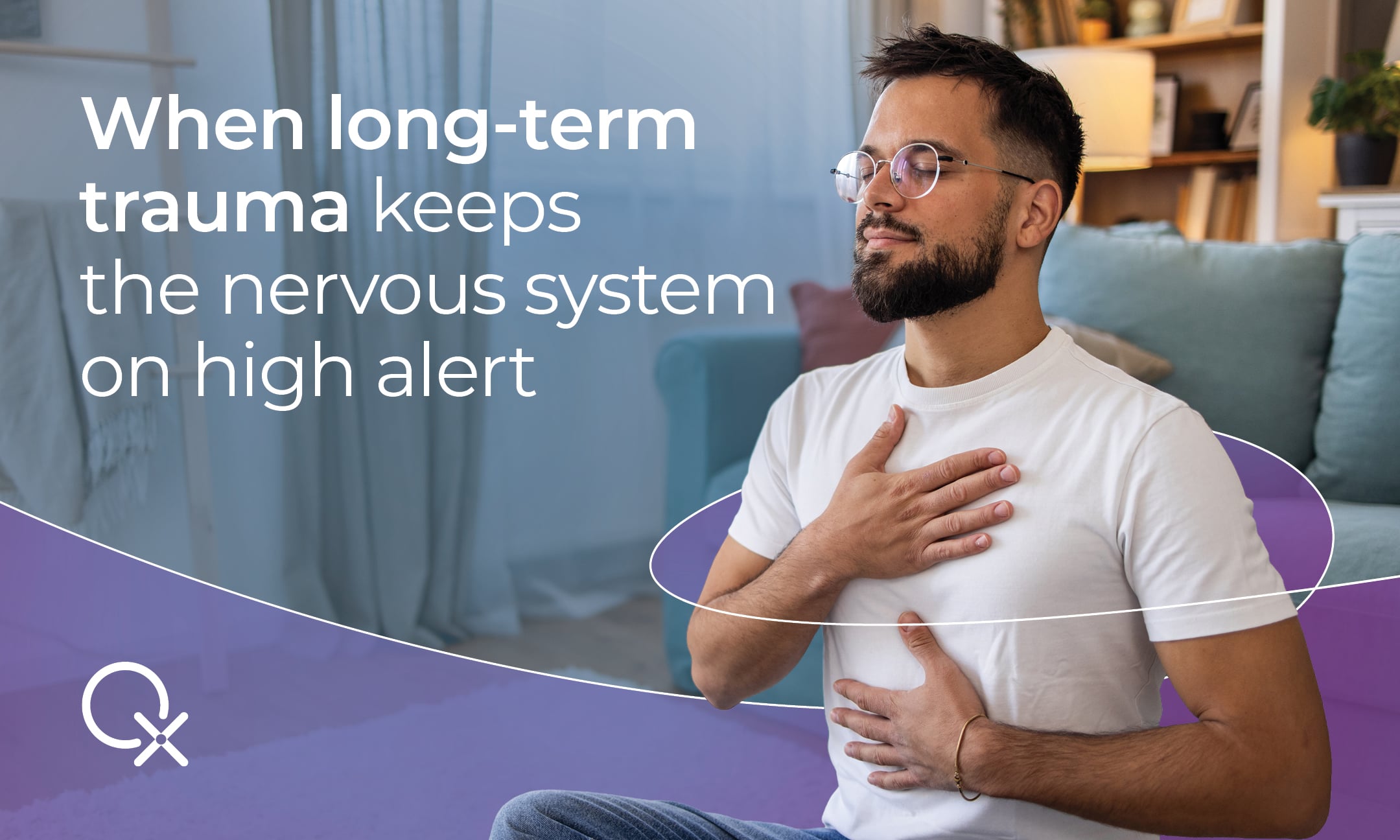

Complex PTSD (CPTSD) is increasingly recognised as one of the most significant long-term effects of prolonged stress and trauma. Unlike trauma linked to a single event, complex PTSD reflects how the nervous system adapts over time to ongoing threat, especially when safety, control, and predictability are repeatedly disrupted. It can develop through experiences such as childhood trauma, ongoing relationship or domestic abuse, coercive control, or exploitation—including trafficking—where a person has to stay alert for long periods, making survival responses feel automatic.
Today, complex PTSD is formally recognised in the ICD-11 (International Classification of Diseases, 11th Revision.) and widely discussed across trauma research, psychology, and nervous system–based health disciplines. Many people search what is complex PTSD or complete a CPTSD test after years of emotional distress, relational difficulties, or chronic stress patterns that do not improve even when life circumstances change. Symptoms can show up as hypervigilance, shutdown, shame, or difficulty trusting.
At its core, CPTSD explains why the body and nervous system remain on high alert long after danger has passed—often until the system learns safety again through support, stability, and regulation.
Complex PTSD is a trauma-related condition that develops after repeated, prolonged, or inescapable stress, often during childhood or long-term relational environments.
In simple terms, complex PTSD involves:
People often seek a CPTSD test when symptoms feel confusing, inconsistent, or resistant to standard stress-management approaches.
While PTSD and complex PTSD share some features, they are not the same condition.
PTSD typically follows:
Complex PTSD develops through:
This distinction is essential for understanding symptoms and appropriate support.
Complex PTSD is frequently overlooked because symptoms may resemble:
Many people complete multiple CPTSD test screenings before recognising the broader pattern. Without awareness of complex PTSD, individuals may internalise symptoms as personal failure rather than adaptive responses.
Complex PTSD is shaped by environments involving:
These conditions train the nervous system to prioritise survival over regulation.
A defining feature of complex PTSD is the loss of felt safety.
When safety is unreliable:
This is why complex PTSD often affects identity and self-perception.
Complex PTSD symptoms extend beyond classic PTSD features and affect multiple systems—emotional, cognitive, physical, and relational. People may experience intense emotional swings or emotional numbness, persistent hypervigilance, and a strong inner sense of shame or negative self-beliefs. Sleep disruption, chronic tension, startle responses, and fatigue are also common. In relationships, complex PTSD can show up as difficulty trusting, fear of conflict, people-pleasing, withdrawal, or struggling with boundaries. Symptoms often fluctuate, especially during stress, and can feel confusing because the nervous system may react as if the original threat is still present.
People with CPTSD may experience:
These responses reflect nervous system overload, not weakness.
Cognitive and Behavioural Patterns
Complex PTSD commonly involves:
Many people recognise these patterns when taking a structured CPTSD test.
Complex PTSD often affects:
These patterns develop as survival strategies in unsafe environments.
Chronic trauma reshapes autonomic nervous system regulation.
Key effects include:
In complex PTSD, fight, flight, and freeze responses can become baseline states rather than brief, situational reactions. Instead of activating only in moments of real danger, the nervous system may stay partially—or fully—oriented toward survival even during everyday, non-threatening situations.
This can look different from person to person. Some remain in a chronic fight or flight state, marked by tension, irritability, restlessness, overthinking, or a constant need to stay busy or alert. Others shift more toward freeze, experiencing shutdown, numbness, low energy, dissociation, or difficulty initiating action. Many people move between these states depending on stress levels, relationships, or perceived demands.
Because these responses were once protective, the nervous system learned to rely on them automatically. Over time, they no longer require a clear trigger. This is why symptoms can persist even during calm periods—the body is responding to learned threat, not present danger. Healing involves helping the nervous system gradually recognise safety again, so these survival responses no longer have to remain “on” by default.
Cause → Effect → Consequence:
Complex PTSD vs PTSD – Key Differences
Feature | PTSD | Complex PTSD |
Trauma Type | Single event | Repeated, prolonged |
Sense of Safety | Disrupted | Fundamentally altered |
Emotional Regulation | Trigger-based | Chronic dysregulation |
Self-Perception | Often intact | Persistently negative |
Relationship Impact | Variable | Frequently significant |
Awareness is not about labels—it is about recognising patterns without judgment.
Self-observation helps individuals:
Biofeedback is a non-invasive, insight-based approach that helps people notice how their body responds to stress in real time. It focuses on physiological patterns—such as tension, breathing rhythms, and other stress-linked signals—so individuals can build clearer awareness of what’s happening internally. Biofeedback is not diagnostic and not a medical treatment. Its value is in information and self-observation: seeing patterns, tracking change, and learning what supports a steadier state.
For individuals experiencing CPTSD patterns, biofeedback may help by:
This kind of insight can make it easier to apply supportive tools—such as therapy, grounding, breathwork, structured routines, and paced exposure—because the person can recognise earlier when their system is shifting into survival mode and respond with more choice.
Supportive principles include:
Progress with complex PTSD is gradual and non-linear. Many people improve through small, repeated steps: noticing earlier, recovering faster, and building more capacity over time—even if occasional setbacks still occur.
Complex PTSD reflects how prolonged stress shapes the nervous system—not personal failure. Understanding CPTSD reduces stigma and supports informed, compassionate pathways toward regulation and resilience. Supportive approaches, including awareness-based tools such as biofeedback, can help individuals build safety, adaptability, and long-term wellbeing.
Learn more about quantum biofeedback and how it can help support CPTSD by watching the recording of our related webinar.